From error to merged fix
The loop runs on its own. A person makes one decision, and every step leaves a record you can open.
-
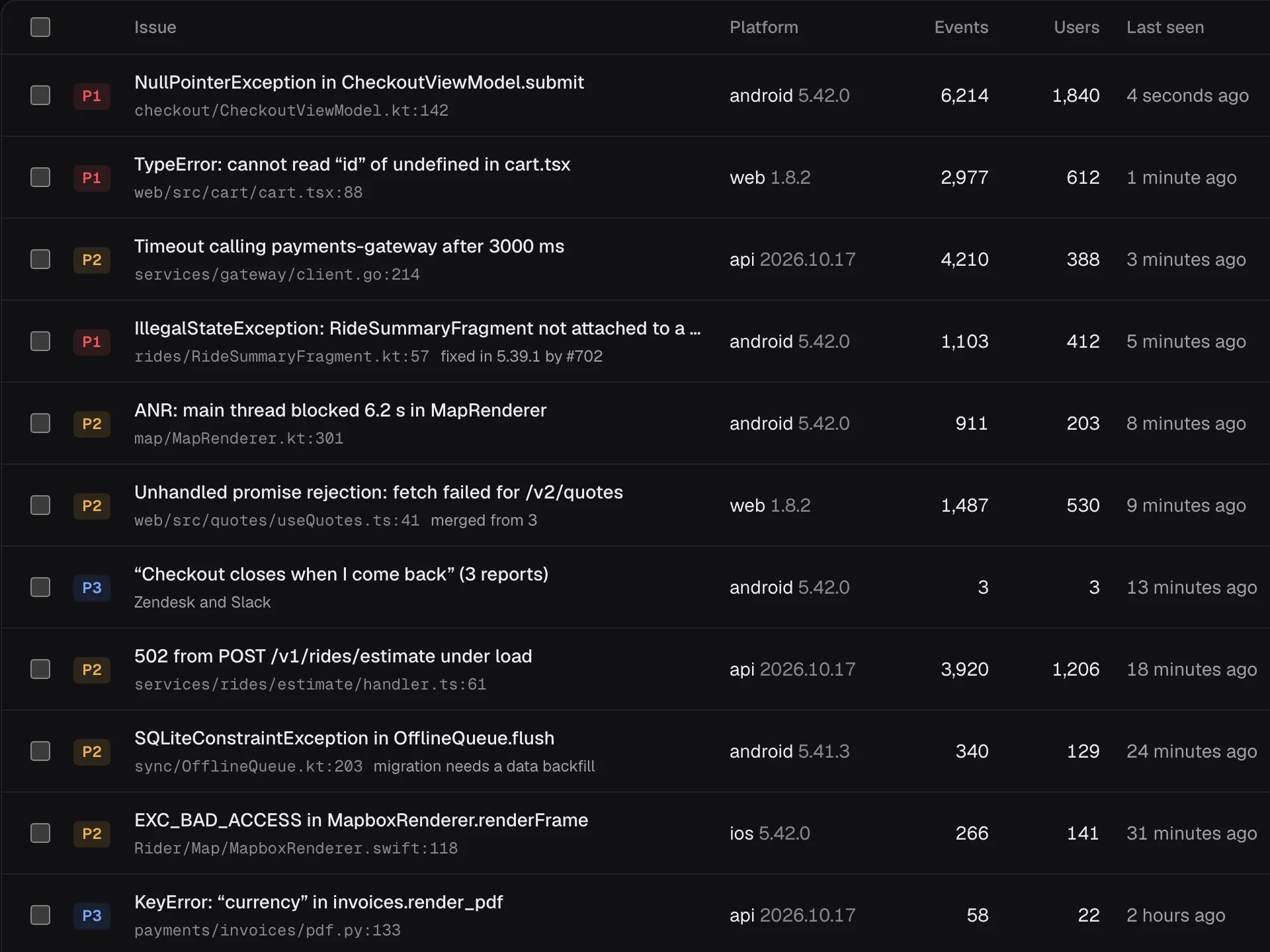
An error comes in and becomes one issue.
Events from Sentry, your logs or our SDK are grouped by fingerprint, scored P0 to P4 and given an owner from your CODEOWNERS file. A ticket opens in Jira or Linear if you want one.
-
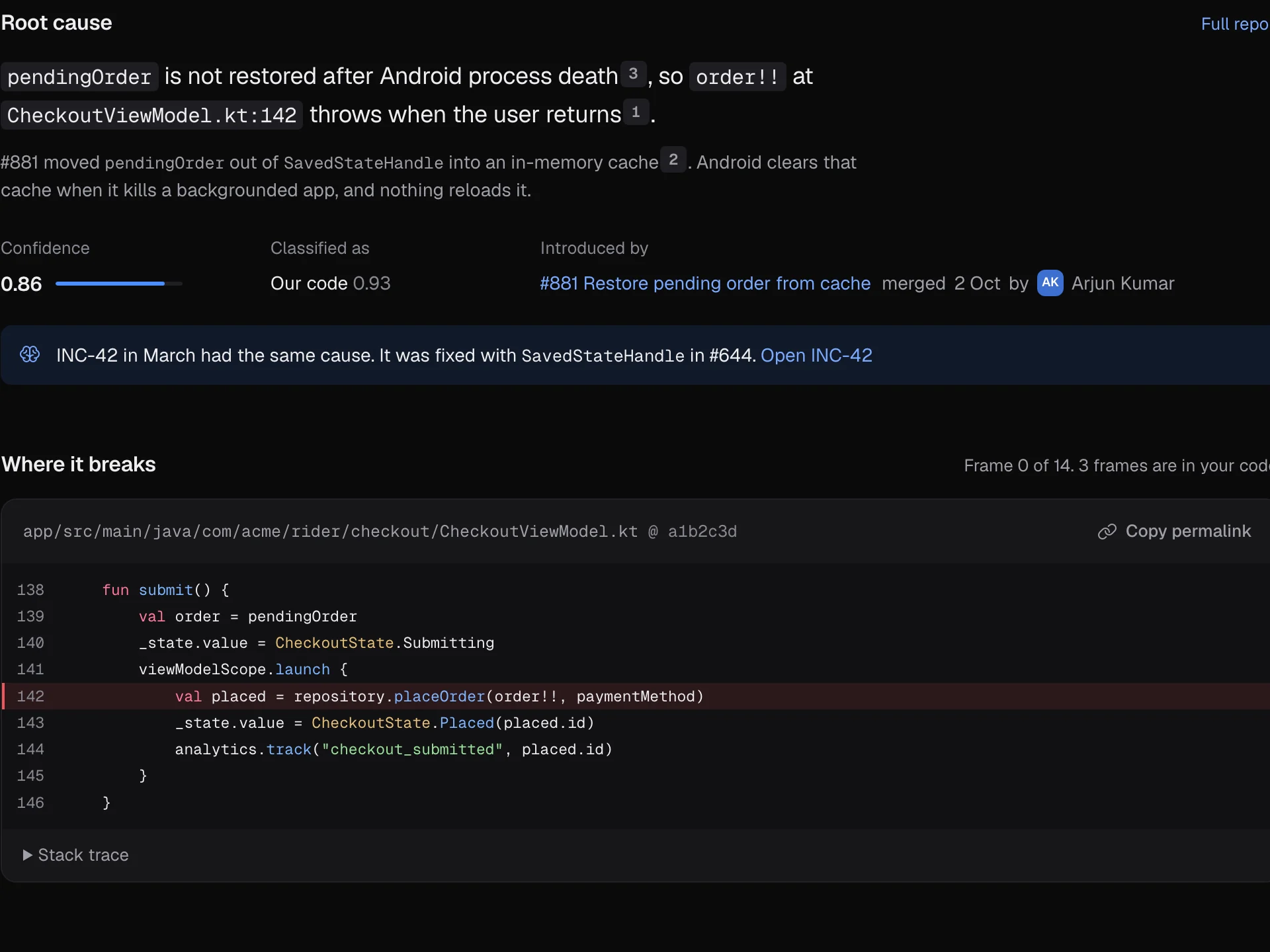
Then it finds the line that broke.
It reads the stack trace, recent commits, logs and past incidents, names the change that caused it and links every claim to its evidence. A claim without a source is dropped.
-
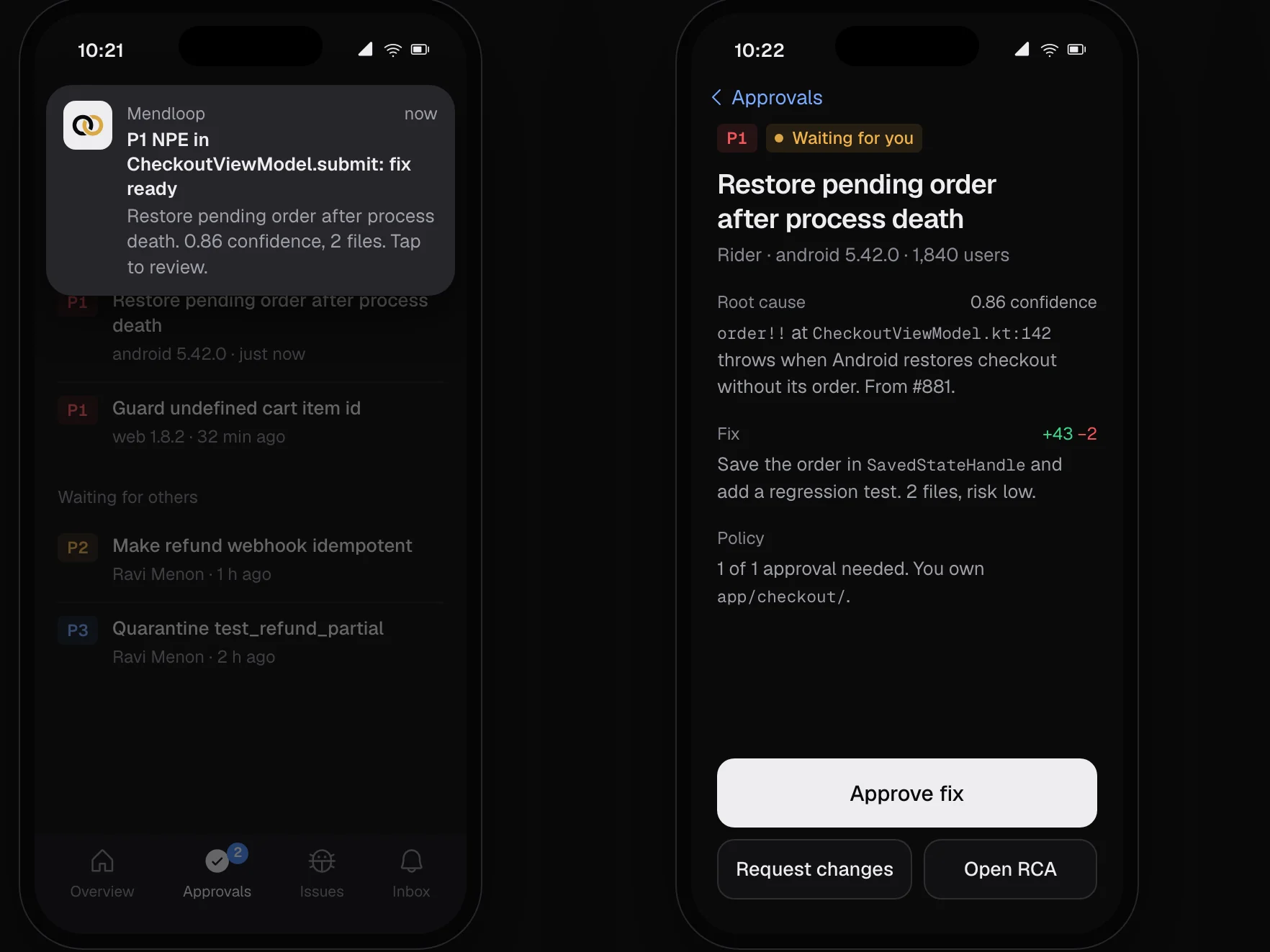
The code owner says yes, once.
One message in Slack, Teams, email or on the phone, carrying the cause and the change. Approve, request changes, reassign or mark it not a bug. Reminders follow your rules.
-
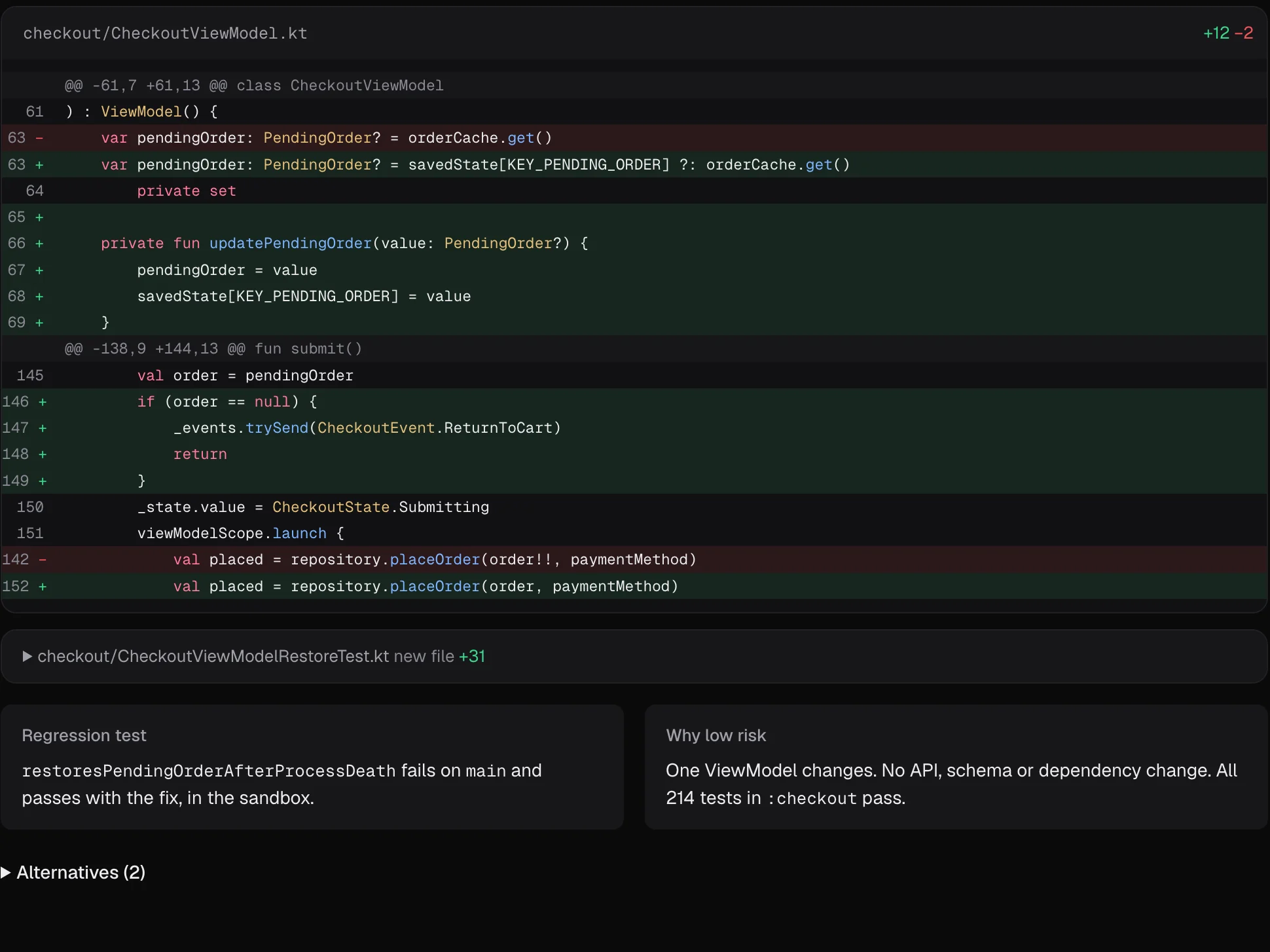
A tested pull request opens.
On a new branch from main: the fix and a regression test that fails before and passes after. Build, lint and your tests run in a sandbox. Mendloop never pushes to main.
-
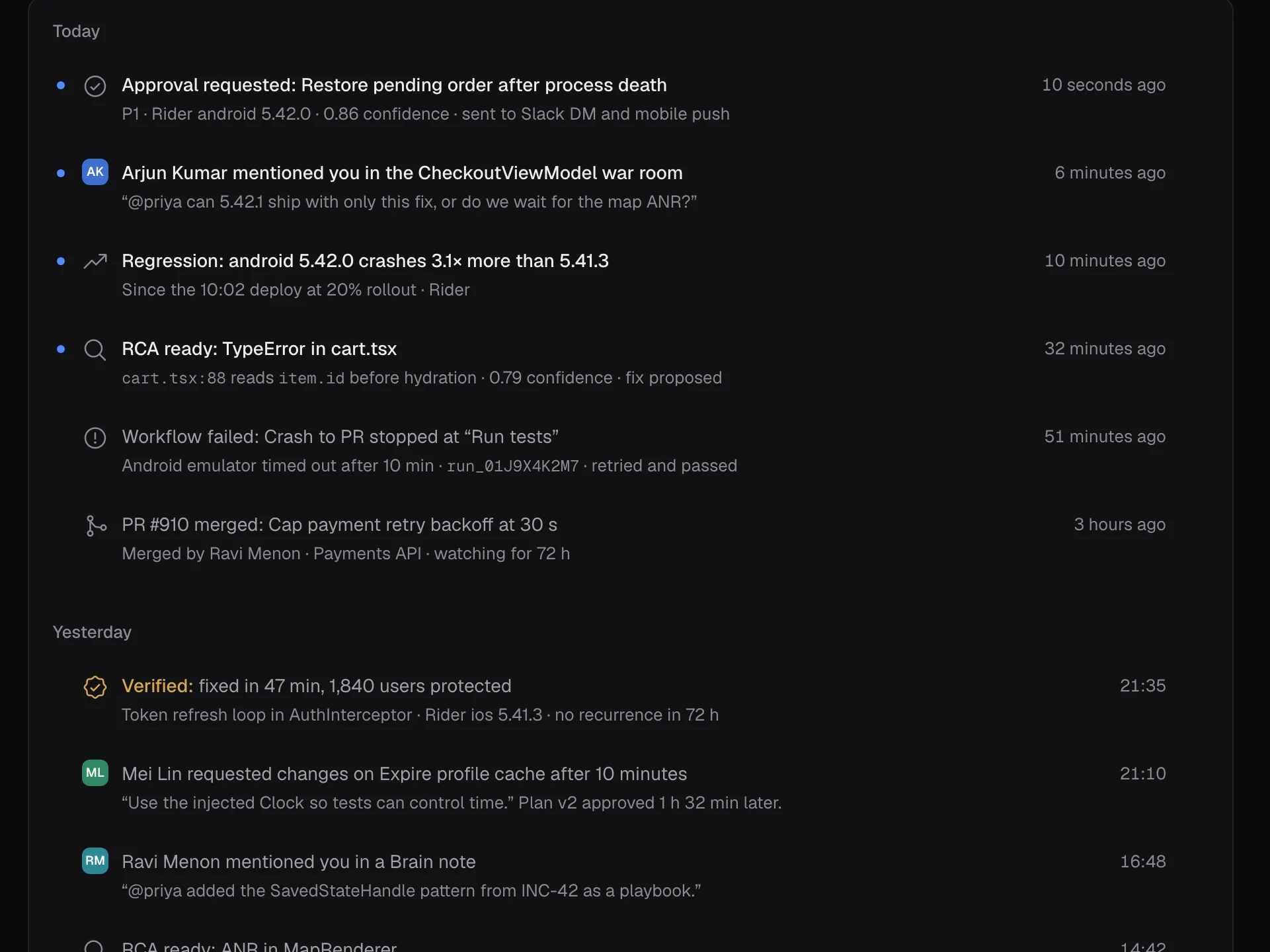
Merged, and the ticket closes.
Your reviewers merge as usual. The ticket moves to Done, and everyone involved hears about it in the same chat thread.
-
Verified, then remembered.
Mendloop watches the next release. If the error stays gone the issue is verified; if it comes back, the issue and the ticket reopen. The Brain keeps the cause, the fix and what your team turned down.
What makes Mendloop different
Six settings from the product, as switches. Turn one on to read what it does.
Read-only until an owner approves.
Every connection starts with read scopes. Write access is a separate grant, requested the first time a fix needs it and issued for that one branch. A single switch stops every write.
Every claim cites its evidence.
Each sentence of a root cause links to the log line, commit, trace or past incident behind it. A claim with no citation is dropped before anyone reads it.
Test mode for every workflow.
Test mode has its own data and targets: #mendloop-test, Jira TEST and a fork of your repo. Any write without a test target is simulated and recorded, never sent.
Any model, including local ones.
OpenAI, Anthropic, Gemini, Mistral, Bedrock, Azure or any OpenAI-compatible URL. We recommend Claude for root causes and fixes; small local models on Ollama or vLLM still work, through plan-then-fetch.
Nothing personal is stored.
User IDs, emails and IP addresses are kept as keyed hashes, HMAC-SHA256 with a key per organization. Mendloop can say 1,840 users hit a crash, never who they were.
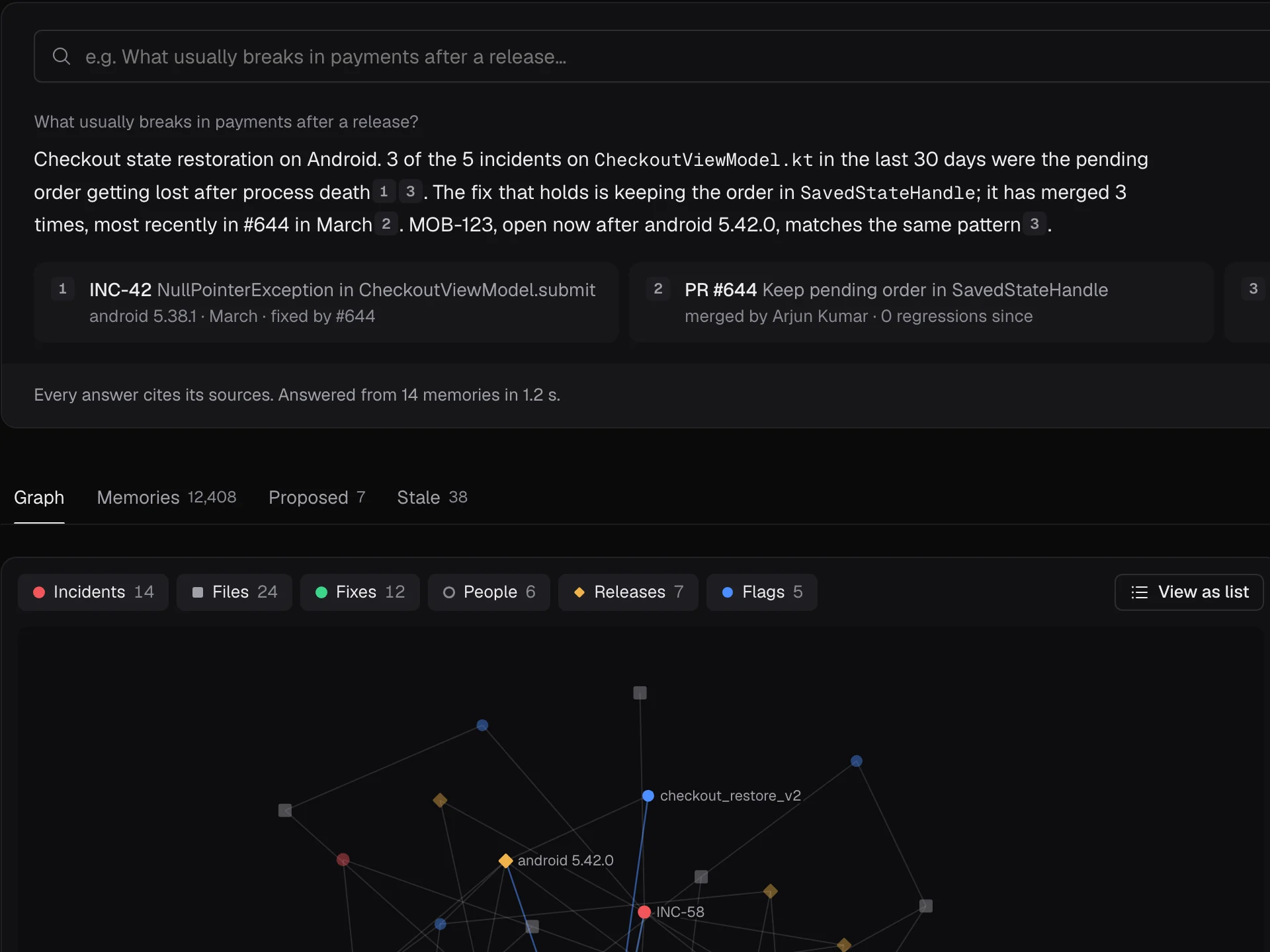
Every fix is remembered.
Each incident, fix and rejected approach is kept with its source. INC-42 in March is why MOB-123 was fixed with SavedStateHandle in 47 minutes.

Mended in gold
Kintsugi repairs a broken bowl with lacquer and gold, so the mend stays visible and becomes part of the bowl’s history.
That is the idea behind the name. A fix should not vanish into a commit nobody reads: each one keeps its cause, its evidence, who approved it and how it held up in the next release. The seam in our mark is that gold line.
Tea bowl, Korea, Joseon dynasty, 16th century, repaired with gold lacquer. Ethnological Museum, Berlin. Photograph by Daderot, CC0.
Works with what you run.No new SDK needed.
Read the setup guideAlready on Sentry? Change one line, the DSN, and any Sentry SDK reports to Mendloop. Gold marks what works in the beta today; the rest is on the way.
// any Sentry SDK: point the DSN at Mendloop, nothing else changes
Sentry.init({ dsn: "https://YOUR_PUBLIC_KEY@ingest.getmendloop.com/42" });- AvailableReads issues and events. Resolves only with approval.SentryConnect the API, or keep your Sentry SDK and change the DSN.
- AvailableSpeaks the Sentry envelope formatMendloop browser SDKOne script tag. Inputs are masked in the browser before anything is sent.
- ComingTwo lines in your appAndroid and iOS SDKsWith ProGuard mapping and dSYM upload in the build.
- ComingSame envelope formatReact Native and FlutterThin wrappers over the native SDKs.
- ComingReads crashesCrashlyticsConnect the project; nothing to install.
- ComingReads errorsBugsnagConnect the organization; nothing to install.
- ComingFrom your terminal or editorCLI and MCP server
npx mendloop initadds the SDK and sends a test error.
- AvailableWrite token only after approval, for one branchGitHubA GitHub App on the repositories you pick. Reads code, history and CODEOWNERS.
- ComingSame read-first modelGitLabGitLab.com or self-managed, with a group access token.
- ComingSame read-first modelBitbucketBitbucket Cloud workspaces.
- ComingAllow-listed hosts onlyAzure DevOps, Gitea, any Git URLPrivate networks through the relay agent, an outbound-only tunnel.
- AvailablePosts to the channels you chooseSlackApproval requests with buttons in the message, and the run in one thread.
- ComingAnswers checked against the signed-in accountMicrosoft TeamsThe same approval card, in a chat with the bot.
- ComingFor people without chat linkedEmailSigned links that expire after one use or seven days.
- ComingPosts to one channelDiscordApprovals and run updates in a channel.
- AvailableTwo-way status syncJiraCreates the ticket, maps fields, moves it to In Progress, In Review and Done.
- AvailableTwo-way status syncLinearThe same lifecycle, with your team’s states.
- AvailableTwo-way status syncGitHub IssuesOpens and closes issues next to the pull request.
- ComingTwo-way status syncZoho ProjectsField mapping and status sync.
- AvailableYour key, or included cloud creditsAnthropic ClaudeRecommended for the strongest tier: root causes, fix plans and the code fix.
- AvailableThrough LiteLLMOpenAI, Gemini, Mistral, DeepSeek, GrokMap each to the fast, balanced or strongest tier, with fallbacks.
- AvailableCovered by your cloud agreementBedrock, Vertex AI, Azure OpenAIUse your cloud account and its region.
- AvailableCode and logs stay on your networkOllama, vLLM, LM StudioLocal models. A local-only switch blocks every external provider.
- AvailableBudgets per org, project and runAny OpenAI-compatible URLGroq, OpenRouter or your own gateway.
- ComingReceive onlyOpenTelemetry (OTLP) and log drainsNew and spiking log templates become signals.
- ComingRead-only queriesDatadog, Loki, Elastic, CloudWatchInvestigators query your logs around the crash.
- ComingReads ticketsZendesk, Intercom, Zoho DeskSupport tickets link to the issue; replies are drafted, never sent on their own.
- ComingCached for 10 minutesHubSpotCustomer impact by account, fetched when needed and never stored.
- ComingRead, page on rulesPagerDuty and feature flagsPages for P0 issues; flag changes as evidence.
Every connection ends with a verify run: auth, scopes, a sample read and a webhook round trip. Health is checked again every 15 minutes.
Open source and self-hosting
- Licence
- Apache-2.0
- Needs
- Postgres 16 and Redis 7
- Smallest install
- 2 vCPU, 4 GB memory
Mendloop’s core is Apache-2.0. Beta teams can self-host it on request; the public repository opens at release. The code that runs our cloud is the code you can run: the investigators, the approval gate, the fix sandbox and the Brain. Self-host it with Postgres and Redis and nothing else, bring your own model keys or run local models, and no telemetry leaves your install unless you turn it on.
Two commands
# needs Docker, git and make
$ git clone https://github.com/mendloop/mendloop && cd mendloop   # beta access; public at release
$ make setup        # .env with fresh keys, Postgres and Redis, migrations
$ docker compose up -dWhat’s in it
Core, Apache-2.0
- Ingest, issues, dedupeSentry, SDKs
- Root-cause investigatorsAny model
- Approvals and remindersChat, phone
- Fix sandbox and pull requestsDocker or CI
- Test modeDry-run writes
- The Brainpgvector
- Privacy layerHash, scrub
ee/, with a licence key
- Single sign-onOIDC, SAML
- SCIM provisioningEnterprise
- Audit log exportBusiness
- Advanced approval policiesEnterprise
Built to forget
If our database leaked, it would reveal as little as possible about anyone. Mendloop needs to know that 1,840 users hit a crash, not who they are. How we handle data
{{secrets.*}}All a model ever sees of a secretPricingCompare every feature |
Open source$0 foreverOn your servers | Team$29 per seat a monthMendloop Cloud | Business$79 per seat a monthMendloop Cloud | EnterpriseCustomCloud or your servers |
|---|---|---|---|---|
| Events a month | Your hardware | 1 million | 5 million | Custom |
| Investigations a month | Unlimited | 300 | 1,500 | Custom |
| AI models | Your keys or local | $5 credits per seat, or your keys | $15 credits per seat, or your keys | Custom, or your keys |
| Event retention | You decide | 30 days | 90 days | Custom |
| Sign-in | GitHub, Google, email | GitHub, Google, email | SSO with OIDC | SAML and SCIM |
| Support | Community | Priority | SLA | |
| Request self-host access | Request access | Request access | Talk to us |
Pricing
Open source
$0 forever
- Events a month
- Your hardware
- Investigations
- Unlimited
- AI models
- Your keys or local
- Support
- Community
Team
$29 per seat a month
- Events a month
- 1 million
- Investigations
- 300 a month
- AI models
- $5 credits per seat a month
- Event retention
- 30 days
Business
$79 per seat a month
- Events a month
- 5 million
- Investigations
- 1,500 a month
- Sign-in
- SSO with OIDC
- Event retention
- 90 days
Enterprise
Custom
- Sign-in
- SAML and SCIM
- Where
- Cloud region of your choice, or your servers
- Support
- SLA
Questions
-
No. Connect Sentry’s API, or change one line in any Sentry SDK, the DSN, to point at Mendloop. Your Sentry setup keeps working.
-
Never. It writes the fix on a new branch and opens a pull request. Your reviewers merge it, the same way as any other change.
-
Redacted evidence: stack frames, cited code and log lines, with personal data replaced by tokens like
<email_1>and secrets by{{secrets.*}}. Every prompt is stored after redaction, so you can audit it. -
Any you trust. We recommend Claude for the strongest tier, where root causes and fixes are written. Local models work too, with a switch that blocks every external provider.
-
Request changes and the plan is redone before any code is written. If CI fails on the pull request, Mendloop tries twice more, then reports to the owner. If the error returns after release, the issue and ticket reopen.
-
Anything that produces a stack trace. Code is parsed with tree-sitter, and JavaScript source maps, ProGuard mappings and dSYMs are symbolicated.
-
About 15 minutes for an Admin: connect code, add an error source, pick a model, connect chat and send a test error.
npx mendloop initdoes the SDK and the test error for you. -
Yes. Every core feature is Apache-2.0. Enterprise single sign-on, SCIM, audit export and advanced policies live in
ee/and need a licence key. -
Mendloop is new. The first release covers Sentry, the browser SDK, GitHub, Slack, Jira, Linear, GitHub Issues and every model provider. The rest of the list above is marked as coming.
Approve your first fix
Mendloop is in private beta. Request access and we’ll set up your workspace with you: connect GitHub read-only, send a test error, and approve your first fix within a minute.
Rather run it yourself? Self-hosting is open to beta teams on request.